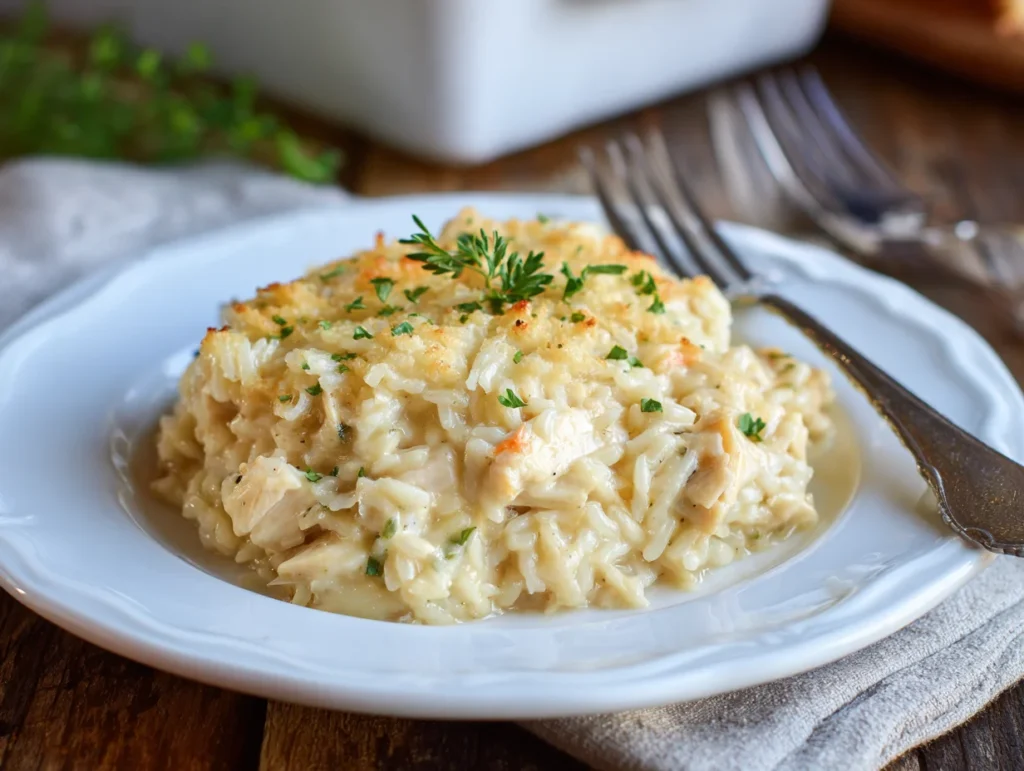
Creamy Rice and Chicken Casserole represents the essence of well-executed comfort cuisine, where simplicity is refined through technique rather than complexity. In professional kitchens, this dish is valued for its structural balance,tender chicken, properly prepared rice, and a carefully emulsified cream sauce that binds everything into a unified whole.
The objective is not heaviness, but controlled richness that feels satisfying without overwhelming the palate. When executed correctly, each component maintains its identity while contributing to a cohesive final dish. The rice absorbs flavor without becoming mushy, and the chicken remains succulent within the creamy matrix.
This casserole is a practical example of how disciplined preparation and timing transform everyday ingredients into a reliable, restaurant-quality comfort meal suitable for both family service and structured meal planning.
?Easy Chicken Pot Pie with Biscuits Recipe
Improper Rice Hydration Leading to Structural Failure
A frequent technical flaw in this preparation is incorrect rice hydration prior to baking. From a culinary standpoint, rice is not merely an ingredient but a structural carrier for the entire dish. When it is under-hydrated or insufficiently cooked before assembly, it fails to absorb the surrounding cream-based sauce evenly.
This results in inconsistent texture,some grains remain firm and underdeveloped while others overabsorb liquid and collapse. Such imbalance compromises the integrity of the casserole, producing a dish that feels disjointed rather than unified. Additionally, improper rice hydration disrupts sauce distribution, leading to excess moisture pooling at the base.
In professional terms, this is considered a failure in moisture management, as the rice should function as a controlled absorber that stabilizes both texture and flavor throughout the baking process.
Controlled Rice Preparation for Structural Consistency
The corrective approach requires precise rice preparation before integration. In professional practice, par-cooking the rice to an al dente stage is essential, ensuring it retains structure while remaining receptive to further moisture absorption during baking.
Rinsing before cooking is also critical, as it removes surface starch that can cause clumping and undesirable gumminess. Once properly prepared, the rice acts as a stable medium, distributing cream and seasoning evenly throughout the casserole. Liquid ratios must also be carefully calibrated to support gradual absorption without oversaturation.
This controlled approach ensures that during baking, the rice finishes cooking uniformly within the sauce environment. The result is a consistent, well-structured base where each grain contributes to the overall creaminess without losing definition, achieving the intended professional standard of texture harmony.
Ingredients List

Base Ingredients:
- 2 cups cooked or par-cooked long grain rice
- 2 cups cooked chicken breast (shredded or diced)
- 1 ½ cups heavy cream or cooking cream
- 1 cup chicken stock
- 1 cup shredded cheddar or mozzarella cheese
- 1 medium onion (finely chopped)
- 2 garlic cloves (minced)
- 2 tbsp unsalted butter
- Salt and freshly ground black pepper to taste
Optional Add-ins:
- Sautéed mushrooms
- Frozen peas or mixed vegetables
- Smoked paprika
- Fresh parsley (finishing)
- Parmesan cheese (for topping)
Step-by-Step Instructions
Develop the Aromatic Base
Begin by establishing the aromatic foundation, which defines the depth of the final dish. In a heated pan, melt butter and gently sauté finely chopped onions until translucent, followed by garlic until fragrant. Add pre-cooked chicken and season lightly to allow gradual layering of flavor.
This stage is not about intensity but controlled development, ensuring that the chicken absorbs aromatics without becoming dry. Proper heat management is essential to avoid caramelization that would overpower the creamy profile. The objective is a balanced savory base that integrates seamlessly into the sauce system later.
Formulate the Cream Emulsion
The cream component must be treated as a structured emulsion rather than a simple liquid mixture. Combine cream and chicken stock over gentle heat, allowing gradual integration before introducing cheese. Stir continuously to achieve a smooth, stable consistency without separation.
The cheese should melt evenly, reinforcing body and viscosity. Seasoning should remain restrained at this stage, as the chicken base already contributes salinity. The final sauce should appear glossy and cohesive, with enough fluidity to penetrate the rice while maintaining enough structure to bind the casserole during baking.
Integrate Components with Precision
Combine rice, chicken mixture, and cream sauce in a large vessel using controlled folding techniques. The objective is even distribution without mechanical breakdown of the rice structure. Each fold should incorporate sauce gradually, ensuring uniform coating rather than pooling.
If vegetables are included, they should be introduced at this stage to maintain textural hierarchy. The mixture should present as balanced and cohesive, neither dry nor excessively wet. This integration phase determines the final structural consistency of the casserole and must be handled with measured precision.
Execute the Baking Process
Transfer the assembled mixture into a prepared baking dish, spreading it evenly to ensure uniform heat exposure. A final cheese layer may be applied for surface development and controlled browning. Baking should occur at moderate temperature to allow gradual moisture absorption and flavor fusion. During this phase, the rice completes its cooking cycle within the cream environment, while the sauce stabilizes into a cohesive matrix. After baking, resting is essential to allow structural settling, ensuring clean portions and consistent texture upon serving.
Cook Time
Total: 50 minutes
Prep: 20 minutes
Bake: 30 minutes
Servings
This preparation yields approximately 4 to 6 servings depending on portioning style. In professional service terms, it functions as a complete plated meal, integrating protein, starch, and sauce in a single cohesive format. The structure is designed to maintain consistency across servings, ensuring that each portion contains balanced ratios of rice, chicken, and cream base. Its stability also makes it suitable for controlled reheating without significant loss of texture when handled correctly.
Makes approximately 4 to 6 servings
Nutritional Information (approx. per serving)
- Calories: 420–480
- Protein: 25–30 g
- Carbohydrates: 35–45 g
- Fat: 18–25 g
- Fiber: 2–4 g
From a nutritional perspective, this dish offers a balanced macronutrient profile suitable for a complete meal. The chicken provides high-quality protein essential for structural repair and satiety, while rice delivers sustained energy through complex carbohydrates. The cream and cheese contribute richness and caloric density, enhancing palatability. When vegetables are incorporated, micronutrient diversity and fiber content improve, adding functional value to the dish.
Storage Instructions
Proper storage is essential to preserve structural integrity and flavor stability. The casserole should be cooled to room temperature before being transferred into an airtight container and refrigerated. Under controlled conditions, it maintains quality for up to three days. Reheating should be conducted gently with added moisture to restore cream consistency. Excessive heat exposure should be avoided, as it may destabilize the emulsion and dry the rice matrix. Freezing is possible but may alter texture due to dairy separation upon thawing.
Suggestions
From a culinary refinement perspective, finishing with fresh herbs or a light cheese crust enhances both aroma and visual appeal. Pairing with acidic or fresh side dishes helps balance the richness of the casserole. Mushrooms or herbs such as thyme can be introduced for additional depth without compromising structural integrity. The dish is particularly effective for structured meal preparation due to its reheating stability and consistent flavor retention when properly executed.
Seasonal Relevance
This casserole aligns most strongly with cooler seasons, where richer, warming dishes are preferred. Its creamy profile and baked structure make it particularly suitable for autumn and winter menus. However, with controlled adjustments such as lighter cream or added seasonal vegetables, it can be adapted for year-round service without losing its core identity as a comfort-focused preparation.
Creamy Rice and Chicken Casserole exemplifies disciplined comfort cooking, where success is determined by control rather than complexity. Each stage—from rice preparation to sauce formulation and final baking—requires technical precision to achieve structural harmony. When properly executed, the dish delivers a cohesive, creamy, and balanced experience that reflects both culinary intention and executional discipline. It stands as a dependable preparation for both home kitchens and professional environments seeking consistency and comfort in equal measure.
? Cozy Casserole Recipe for the Perfect Family Dinner
Frequently Asked Questions
1. Can this casserole be prepared using pre-cooked rotisserie chicken?
Yes, rotisserie chicken is suitable and adds depth of flavor. It should be shredded evenly and incorporated into the aromatic base to ensure consistent seasoning distribution throughout the dish.
2. What type of rice is most suitable for this recipe?
Long grain rice is preferred due to its ability to maintain structure during baking. It absorbs sauce evenly while preventing excessive stickiness or breakdown in texture.
3. How can the cream sauce be prevented from separating?
Maintaining moderate heat and gradual cheese incorporation is essential. Rapid boiling should be avoided, as it destabilizes the emulsion and affects final texture consistency.
4. Can vegetables be added without altering texture balance?
Yes, but they should be pre-cooked or sautéed to remove excess moisture. This ensures they integrate without disrupting the structural balance of the casserole.
5. Is this dish suitable for freezing and reheating?
It can be frozen, but dairy components may slightly change texture upon thawing. Gentle reheating with added moisture helps restore creaminess and overall consistency.
