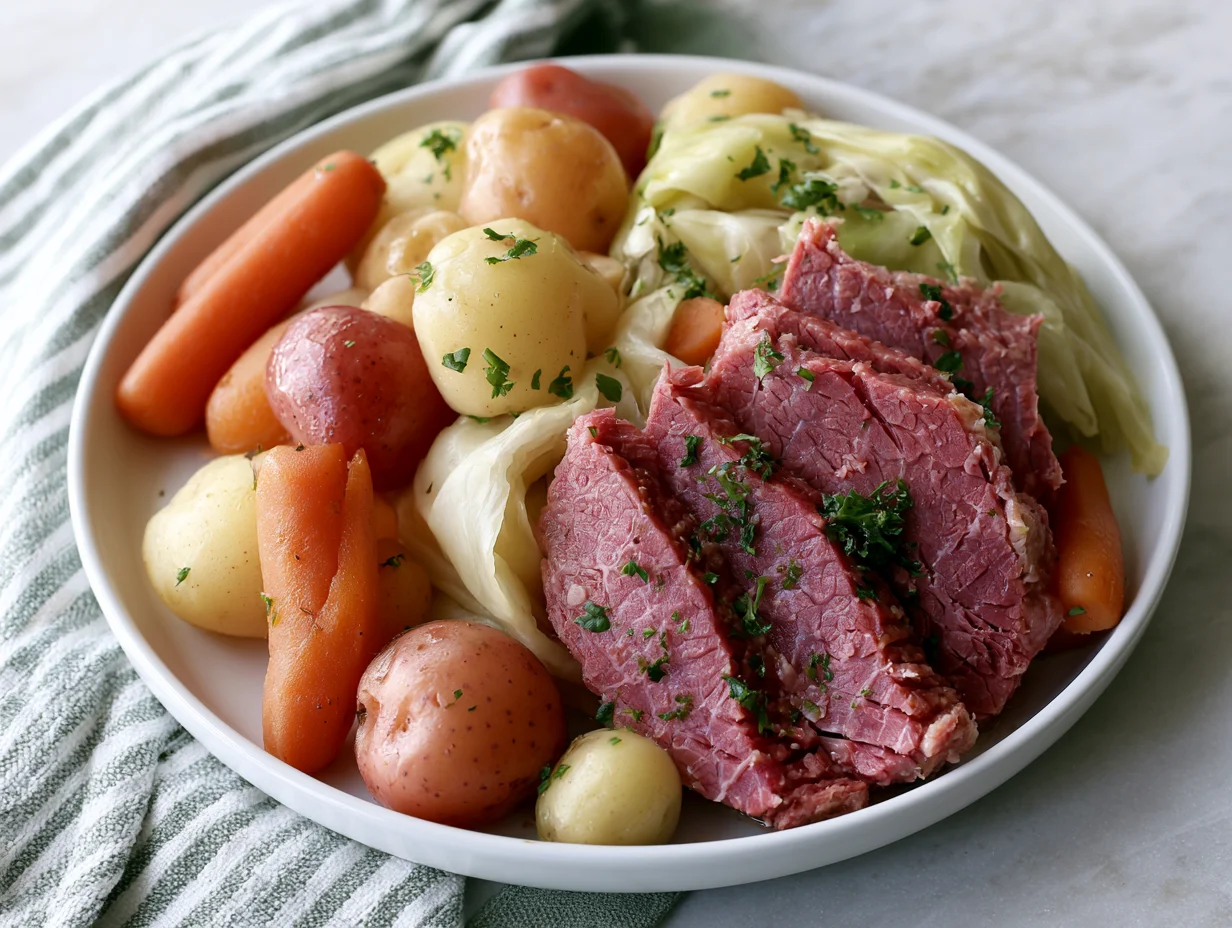
Irish Corned Beef and Cabbage Recipe
There are dishes that feed a table, and then there are dishes that define one. Irish corned beef and cabbage belongs firmly in the second category — a slow-cooked, deeply savory meal that has endured for generations because it simply delivers every single time.
The magic of this dish lies in its restraint. A well-brined brisket, a handful of root vegetables, a head of cabbage, and enough time to let everything come together in one pot. No tricks, no shortcuts, just patient cooking that rewards you with something genuinely remarkable.
What you get at the end is a brisket so tender it yields to the lightest pressure, broth so rich it could be a dish on its own, and vegetables that have absorbed every layer of flavor from the meat and spices simmering around them. It’s the kind of meal that fills a kitchen with a smell that pulls everyone to the table.
Whether you’re cooking it for Saint Patrick’s Day or a slow Sunday dinner, this recipe will give you results that feel earned. It’s not a complicated dish — but it is one that asks for your attention, and that attention is always worth giving.
Ingredients You’ll Need
Before anything else goes into the pot, take a moment to appreciate how few ingredients it takes to build this much flavor — this list is shorter than you’d expect and more powerful than it looks.
One of the things I love about this recipe is that it uses simple pantry ingredients. You probably already have most of them in your kitchen.
Base Ingredients:
- 3 to 4 pounds flat-cut corned beef brisket (with spice packet)
- 1 small head green cabbage, cut into wedges
- 4 medium carrots, peeled and cut into chunks
- 4 medium Yukon Gold potatoes, quartered
- 1 large yellow onion, quartered
- 4 cloves garlic, smashed
- 3 cups low-sodium beef broth
- 3 cups water
- 1 tablespoon whole black peppercorns
- 2 bay leaves
- 1 teaspoon mustard seeds
- Salt to taste
Optional Add-ins:
- 2 stalks celery, cut into thirds
- 1 tablespoon apple cider vinegar (added to the broth)
- 1 teaspoon crushed red pepper flakes
- 1 tablespoon brown sugar (balances the brine)
- 4 sprigs fresh thyme
- 1 tablespoon prepared horseradish (for serving)
- 2 tablespoons whole-grain mustard (for serving)
Step-by-Step Instructions
Step 1: Rinse the Brisket
Remove the corned beef brisket from its packaging and rinse it thoroughly under cold running water. This step is essential — the brisket is packed in a heavily salted brine, and rinsing removes the excess surface salt that would otherwise make the final dish too salty. Pat it dry with paper towels. Open the spice packet that came with the brisket and set it aside; you’ll add it to the pot along with the cooking liquid in the next step.
Step 2: Build the Cooking Liquid
Place the rinsed brisket fat-side up in a large Dutch oven or heavy-bottomed pot. Pour in the beef broth and water — the liquid should come about halfway up the meat, not submerge it completely. Add the smashed garlic, quartered onion, black peppercorns, bay leaves, mustard seeds, and the contents of the spice packet. If using optional add-ins like apple cider vinegar, fresh thyme, or brown sugar, add them now. Bring everything to a full boil over high heat.
Step 3: Slow Braise the Brisket
Once the liquid reaches a boil, reduce the heat to low, cover the pot tightly with a lid, and let the brisket braise gently for 2.5 to 3 hours. The low, steady heat is what breaks down the tough connective tissue in the brisket and turns it tender. Resist the urge to increase the heat — a hard boil will toughen the meat rather than tenderize it. Check occasionally and add a splash of water if the liquid level drops too low.
Step 4: Add the Root Vegetables
After the brisket has braised for 2.5 hours, carefully lift the lid and add the carrot chunks and quartered potatoes directly into the braising liquid. These vegetables need about 25 to 30 minutes to cook through fully. They’ll absorb the spiced, savory broth as they cook, which is precisely what makes them taste so much better than boiled vegetables in plain water. Replace the lid and continue cooking on low heat.
Step 5: Add the Cabbage
When the carrots and potatoes are nearly fork-tender, add the cabbage wedges to the pot. Push them gently into the liquid so they’re partially submerged. The cabbage cooks faster than the root vegetables — it needs only 15 to 20 minutes to become tender while still holding its shape. Avoid overcooking the cabbage; it should be soft and flavorful but not mushy or falling apart. Taste the broth and adjust seasoning if needed at this stage.
Step 6: Rest, Slice, and Serve
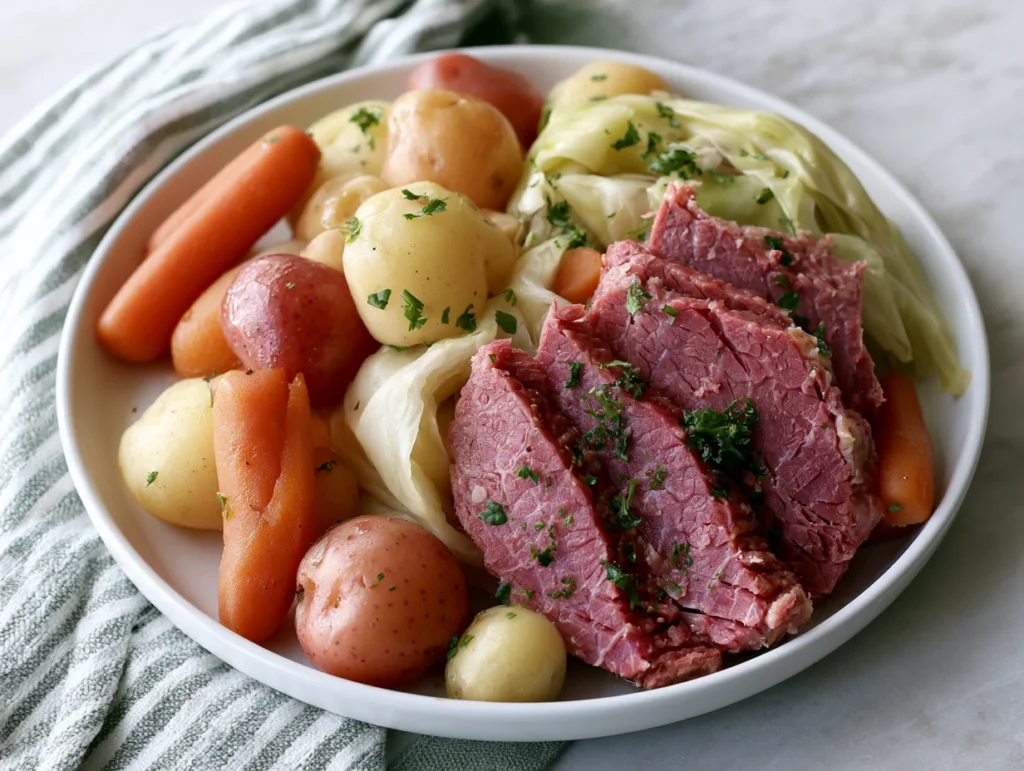
Once everything is cooked through, remove the brisket from the pot and transfer it to a cutting board. Cover it loosely with foil and let it rest for 10 to 15 minutes before slicing. This rest period allows the juices to redistribute through the meat so they don’t run out the moment you cut it. Slice the brisket against the grain into quarter-inch slices. Arrange on a serving platter alongside the vegetables and ladle some of the warm broth over the top before bringing it to the table.
Cook Time
Total:
3 hours 20 minutes (including resting time)
Prep:
15 minutes
Bake:
Cook time: 3 hours (stovetop braise)
Servings
This is a generous, family-style recipe built for the table. The quantities are designed to produce a satisfying, well-portioned meal with enough for second servings and leftovers worth looking forward to the next day.
Makes approximately 6 to 8 servings as a main course. A 3 to 4-pound brisket feeds a table comfortably, and the vegetables extend the meal further. If you’re cooking for a larger gathering, the recipe scales up cleanly — simply use a larger pot and increase the broth and water proportionally.
Leftovers keep exceptionally well and are arguably better the next day once the flavors have had time to deepen. Sliced corned beef reheated gently in its own broth stays moist and tender, making this one of the most practical large-format recipes in any cook’s repertoire.
Common Mistakes in This Recipe
Skipping the rinse on the brisket is the single most common error home cooks make with this dish. The brine the brisket is packed in is extremely salty — far saltier than what you want in the finished dish. Cooking it without rinsing first almost always results in a meal that’s too salty to enjoy, regardless of how well everything else is executed.
Cooking the brisket at too high a temperature is another significant mistake. Braising is a low-and-slow technique by design. Turning up the heat to speed things along results in a tough, stringy brisket that hasn’t had time to properly break down. The connective tissue needs sustained, gentle heat — not a rolling boil — to become tender.
Adding all the vegetables at the start of cooking is a timing error that leads to overcooked, mushy carrots, potatoes, and especially cabbage. Each vegetable has a different cook time, and adding them too early means they fall apart long before the brisket is done. Staggered additions are essential for good texture.
Slicing the brisket incorrectly undermines an otherwise perfectly cooked dish. Corned beef must always be sliced against the grain — cutting with the grain produces long, chewy strands of meat that are difficult to eat. Take a moment to identify the direction of the muscle fibers before making your first cut.
Solutions to Common Mistakes
Always rinse the brisket under cold running water for at least 60 seconds before it goes into the pot. If you’re particularly sensitive to salt, you can soak it in cold water for 30 minutes prior to cooking, changing the water once midway through. This small step makes an enormous difference in the final flavor balance.
Keep the heat firmly on low once the liquid reaches its initial boil. A gentle simmer — where you see occasional small bubbles breaking the surface — is the ideal braising temperature. Use a heavy-bottomed pot with a tight-fitting lid to maintain even, steady heat throughout the long cook.
Follow the staggered vegetable method precisely: root vegetables go in during the final 30 minutes, cabbage during the final 15 to 20 minutes. Set a timer for each addition so nothing is forgotten mid-cook. This approach guarantees every component reaches the table at its best texture simultaneously.
Before slicing, look closely at the surface of the rested brisket and identify the direction the muscle fibers run. Turn your knife perpendicular to those fibers and slice in clean, confident strokes. A sharp carving knife makes the difference between clean slices and ragged cuts.
Nutritional Information (approx. per serving)
- Calories: 420 kcal
- Total Fat: 18g
- Saturated Fat: 6g
- Protein: 34g
- Carbohydrates: 28g
- Dietary Fiber: 5g
- Sugars: 5g
- Sodium: 890mg
- Potassium: 780mg
- Vitamin C: 45mg
- Iron: 4mg
- Calcium: 60mg
Corned beef brisket is a substantial source of complete protein, delivering all essential amino acids needed for muscle repair and maintenance. A single serving provides over 30 grams of protein, making this a genuinely satisfying meal that supports sustained energy throughout the day.
The cabbage in this dish is nutritionally underrated. It’s rich in vitamin C, vitamin K, and dietary fiber, and contains glucosinolates — compounds associated with anti-inflammatory and digestive health benefits. Cooked gently, it retains a meaningful portion of these nutrients.
Carrots contribute beta-carotene, which the body converts to vitamin A, supporting eye health and immune function. Yukon Gold potatoes add potassium, B vitamins, and complex carbohydrates that provide steady energy without a sharp blood sugar spike.
The braising broth itself, when consumed alongside the dish, delivers collagen-rich gelatin from the slow-cooked brisket — a compound associated with joint support and gut health. Skimming the surface fat and ladling the broth over the plated dish adds flavor and functional nutrition in one step.
Storage Instructions
Allow the corned beef and vegetables to cool to room temperature before storing. Transfer everything to airtight containers — keep the sliced brisket and vegetables submerged in a generous amount of the braising broth to prevent the meat from drying out in the refrigerator.
Stored properly, the corned beef and vegetables will keep in the refrigerator for up to four days. The flavor deepens noticeably by day two, making leftovers genuinely worth anticipating. Reheat gently on the stovetop over low heat, adding a splash of broth or water to restore moisture if needed.
For longer storage, the sliced brisket freezes well for up to three months. Portion it into freezer-safe bags with a ladle of broth before sealing to protect against freezer burn. Thaw overnight in the refrigerator and reheat slowly on the stovetop — never in a microwave, which dries out the meat quickly.
The braising broth itself is too valuable to discard. Strain it, cool it, and store it separately in the refrigerator for up to five days. Use it as a base for soup, a braising liquid for other meats, or simply reheat it as a restorative broth on its own. It’s one of the best byproducts this dish produces.
Suggestions
Corned beef and cabbage is complete as a standalone meal, but a few thoughtful accompaniments elevate the experience significantly. Serve it alongside a thick slice of Irish soda bread or rye bread to soak up the braising broth — the combination is one of those pairings that makes immediate, obvious sense.
A side of whole-grain mustard and prepared horseradish belongs on the table whenever this dish is served. The sharpness of both condiments cuts through the richness of the brisket and brightens the entire plate in a way that no other condiment quite replicates.
Leftover corned beef transforms beautifully into corned beef hash the next morning. Dice the cold brisket and potatoes, pan-fry them in a cast iron skillet until crispy on the outside, and top with a fried egg. It’s one of the best uses of leftovers in home cooking, full stop.
For a lighter serving approach, slice the cold brisket thin and use it in a Reuben-style sandwich with sauerkraut, Swiss cheese, and Russian dressing on toasted rye. The flavor of house-braised corned beef in a sandwich is dramatically better than anything deli-sliced, and the effort to get there is already done.
Seasonal Relevance
Irish corned beef and cabbage is most powerfully associated with Saint Patrick’s Day, the one day each year when this dish appears on tables and restaurant menus across the country in enormous quantities. The association is cultural and deeply ingrained, and for good reason — it’s a festive, communal dish that serves a crowd with minimal stress.
Beyond March, this recipe belongs to the broader category of cold-weather braises that make winter cooking deeply satisfying. On a gray January evening or a wet February afternoon, a pot of corned beef slowly building flavor on the stove is one of the more comforting things a kitchen can produce.
In spring, the dish transitions naturally alongside the season. The cabbage becomes sweeter and more tender, and fresh carrots and new potatoes make the plate feel lighter and brighter than the heartier root vegetables of winter. A touch of apple cider vinegar in the broth enhances that spring freshness.
Fall is another strong season for this recipe, as root vegetables reach their peak quality and the drop in temperature makes slow-braised meals feel appropriate again. Cooking a corned beef brisket in October or November, when the kitchen warmth is welcome, produces a dish that feels timely and deeply seasonal in its own right.
Final Words
What this recipe asks of you is not skill — it’s patience. The technique is straightforward, the ingredients are accessible, and the method has been refined by generations of home cooks who knew that low heat and enough time produce results that nothing else can replicate. That’s the real lesson this dish teaches.
Every time you make it, you’ll find small ways to make it your own — a splash of vinegar for brightness, a sprig of thyme for herbal depth, or a longer rest before slicing because you’ve learned how much it matters. Those refinements are how a recipe moves from something you followed to something you actually know.
The dish scales, stores, and repurposes beautifully, which makes it one of the most practical large-format recipes to have in your permanent rotation. It feeds a gathering without demanding your constant attention, and it produces leftovers that are genuinely worth planning around.
Cook it once and you’ll understand immediately why it has lasted as long as it has. Some recipes survive because they’re convenient. This one survives because it’s genuinely, unmistakably good — and every time you make it, that becomes a little more obvious.
Frequently Asked Questions
Do I need to use the spice packet that comes with the corned beef?
Yes, and it’s worth using every bit of it. The packet contains a curated blend of pickling spices — coriander, mustard seeds, bay leaves, and peppercorns — specifically calibrated for the brisket’s brine level. It saves preparation time and delivers balanced, authentic flavor that’s difficult to replicate from scratch.
Can I make Irish corned beef and cabbage in a slow cooker?
Absolutely. Place the rinsed brisket in the slow cooker with the broth, water, and spices. Cook on low for 8 to 9 hours or high for 4 to 5 hours. Add vegetables during the final 2 hours on low or 1 hour on high to prevent them from overcooking and becoming mushy.
What cut of corned beef works best for this recipe?
The flat cut is the better choice for this recipe. It’s leaner, more uniform in thickness, and slices cleanly into neat portions. The point cut has more fat marbling and richer flavor, but it shreds rather than slices, making presentation less defined. Either works — the flat cut simply plates more elegantly.
Irish Corned Beef and Cabbage Recipe
6
servings15
minutes3
hours420
kcal3
hours15
minutesA slow-braised, deeply savory Irish classic — tender brisket, sweet cabbage, and hearty root vegetables in a richly spiced broth. Simple ingredients, patient cooking, and extraordinary results every single time.
Ingredients
3 to 4 pounds flat-cut corned beef brisket, with spice packet
1 small head green cabbage, cut into wedges
4 medium carrots, peeled and cut into chunks
4 medium Yukon Gold potatoes, quartered
1 large yellow onion, quartered
4 cloves garlic, smashed
3 cups low-sodium beef broth
3 cups water
1 tablespoon whole black peppercorns
2 bay leaves
1 teaspoon mustard seeds
Salt to taste
Optional add-ins
2 stalks celery, cut into thirds
1 tablespoon apple cider vinegar
1 teaspoon crushed red pepper flakes
1 tablespoon brown sugar
4 sprigs fresh thyme
1 tablespoon prepared horseradish, for serving
2 tablespoons whole-grain mustard, for serving
Directions
- Rinse the corned beef brisket thoroughly under cold running water for at least 60 seconds to remove excess surface salt from the brine. Pat dry with paper towels. Open the spice packet and set it aside for the next step.
- Place the brisket fat-side up in a large Dutch oven or heavy-bottomed pot. Pour in the beef broth and water. Add smashed garlic, quartered onion, black peppercorns, bay leaves, mustard seeds, and the full contents of the spice packet. Add any optional add-ins at this stage. Bring to a full boil over high heat.
- Once boiling, reduce heat to low and cover tightly with a lid. Let the brisket braise gently for 2.5 to 3 hours. Maintain a gentle simmer — not a hard boil. Check occasionally and add a splash of water if the liquid level drops too low during cooking.
- After 2.5 hours of braising, add the carrot chunks and quartered potatoes directly into the braising liquid. Replace the lid and continue cooking on low heat for 25 to 30 minutes, until the root vegetables are nearly fork-tender and have absorbed the spiced broth.
- Add the cabbage wedges to the pot, pushing them gently into the liquid until partially submerged. Cook for a further 15 to 20 minutes until the cabbage is tender but still holding its shape. Taste the broth and adjust seasoning with salt and pepper if needed.
- Remove the brisket from the pot and transfer to a cutting board. Tent loosely with foil and rest for 10 to 15 minutes. Identify the grain of the meat and slice against it into quarter-inch slices. Arrange on a serving platter with vegetables and ladle warm broth over the top before serving.
Recipe Video
Notes
- Always rinse the brisket before cooking. Skipping this step results in an overly salty dish that no amount of seasoning can correct.
- Keep the heat firmly on low after the initial boil. A hard simmer toughens the brisket — patience is what makes it fork-tender.
- Add vegetables in stages: root vegetables in the last 30 minutes, cabbage in the last 15 to 20 minutes. This prevents everything from turning mushy.
- Always slice the brisket against the grain. Cutting with the grain produces long, tough, chewy strands instead of clean, tender slices.
- Rest the brisket for at least 10 minutes before slicing so the juices redistribute through the meat instead of running out on the cutting board.
- Save the braising broth — strain it and refrigerate for up to 5 days. Use it as a soup base, braising liquid, or reheat it as a standalone broth.
- Leftovers keep in the fridge for up to 4 days. Store the sliced brisket submerged in broth to prevent it from drying out between servings.
- The flat-cut brisket is recommended over the point cut for cleaner slicing and more uniform portions on the plate.