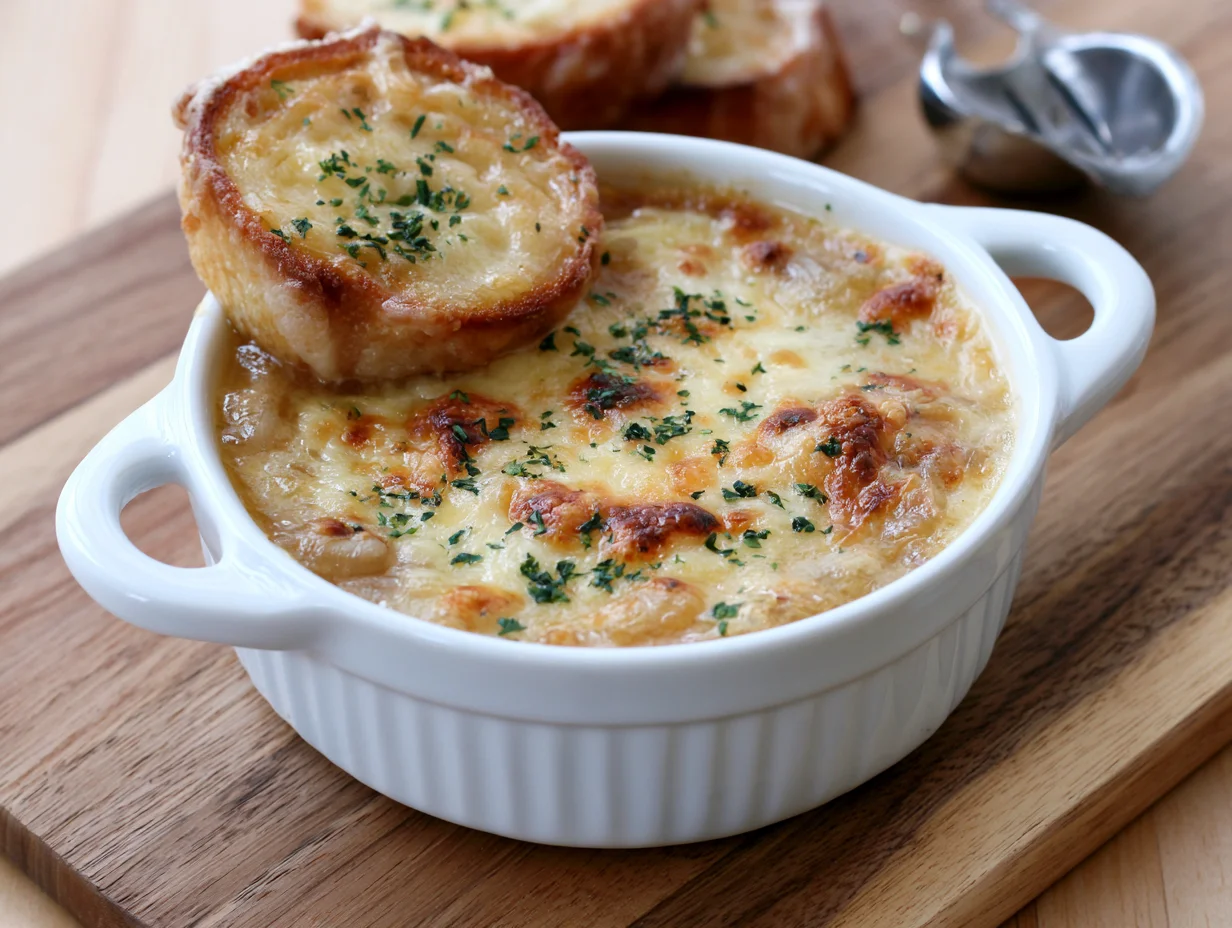
Classic French Onion Soup Recipe
Some recipes exist purely to nourish. Others exist to remind you why cooking matters in the first place. Classic French Onion Soup belongs firmly in the second category — a dish so deeply layered in flavor and history that a single bowl feels like more than just a meal.
The secret to this soup has never been complexity. It has always been patience. The long, slow caramelization of onions is where everything begins and where most home cooks either commit fully or cut corners. That single step is what separates a forgettable broth from something genuinely extraordinary.
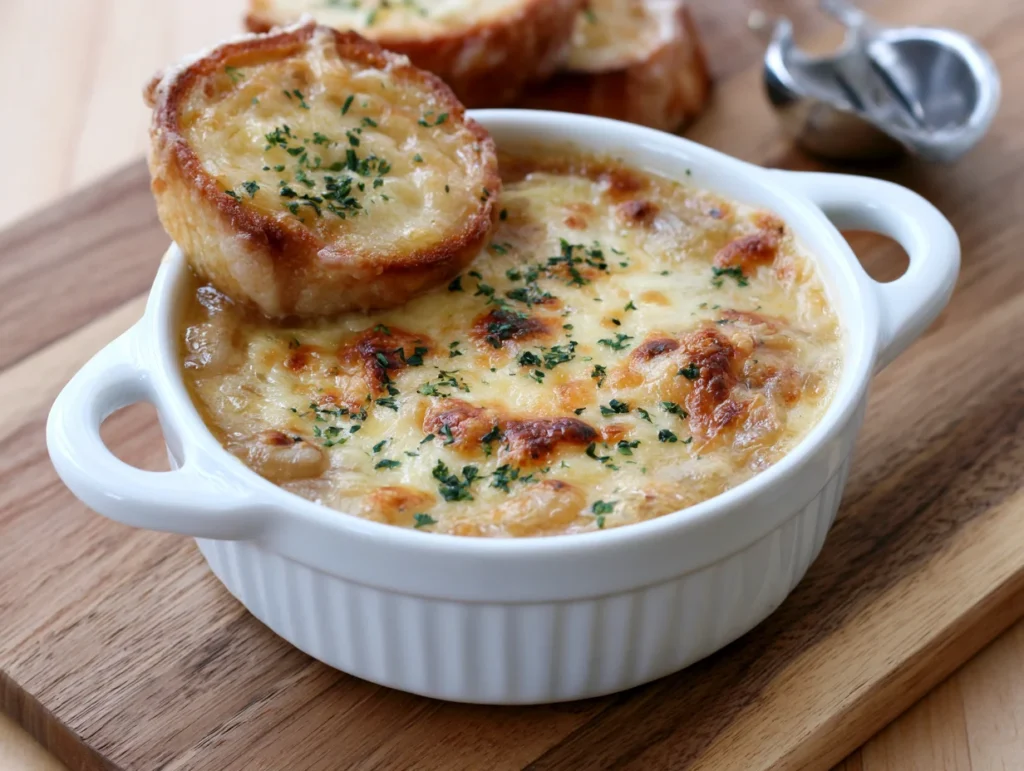
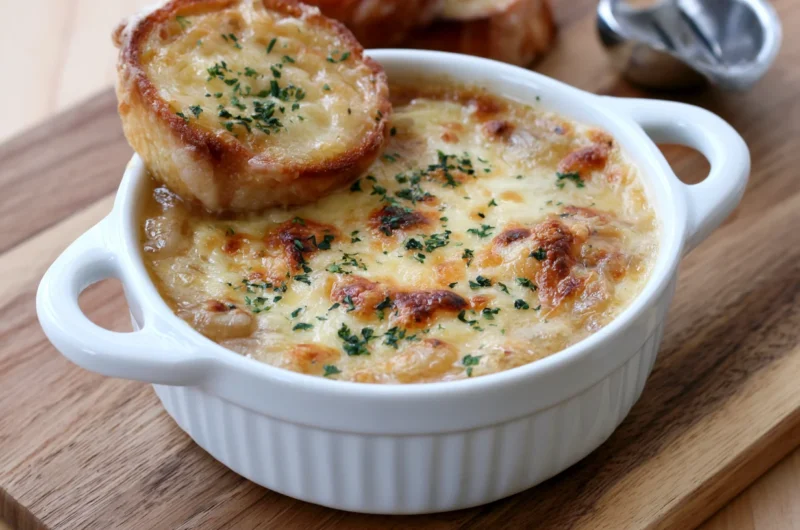
What emerges from a properly made French onion soup is a broth that is rich, sweet, savory, and deeply satisfying — topped with a thick slice of toasted bread and a blanket of molten, golden Gruyère that stretches with every spoonful. It is the kind of dish that silences a table.
This recipe walks you through every stage with the detail it deserves — from the first slice of onion to the final broil. Follow it carefully and you will produce a bowl that rivals the best bistros in Paris, made entirely in your own kitchen.
Ingredients You’ll Need
Every ingredient in this recipe pulls its weight — nothing is decorative, nothing is filler, and the moment you smell the onions beginning to caramelize in butter, you will understand exactly why each one was chosen.
One of the things I love about this recipe is that it uses simple pantry ingredients. You probably already have most of them in your kitchen.
Base Ingredients
- 6 large yellow onions, thinly sliced (about 1.2kg / 2.6 lbs)
- 4 tablespoons unsalted butter
- 1 tablespoon olive oil
- 1 teaspoon granulated sugar
- 1 teaspoon salt
- ½ teaspoon ground black pepper
- 3 cloves garlic, minced
- 2 tablespoons all-purpose flour
- ½ cup dry white wine (or dry vermouth)
- 4 cups beef broth (good quality, low sodium)
- 2 cups chicken broth
- 2 teaspoons Worcestershire sauce
- 2 sprigs fresh thyme (or ½ teaspoon dried thyme)
- 1 bay leaf
- 4 slices French baguette, about 2cm thick
- 1½ cups Gruyère cheese, freshly grated
- 2 tablespoons fresh parsley, chopped (for garnish)
Optional Add-ins
- 2 tablespoons cognac or brandy (adds remarkable depth to the broth)
- ¼ cup dry sherry (in place of white wine, for a nuttier profile)
- ½ teaspoon fresh ground nutmeg (a classic French addition to the broth)
- ¼ cup Parmesan, freshly grated (blended with Gruyère for extra complexity)
- 1 teaspoon Dijon mustard (stirred into the broth for subtle sharpness)
- 1 tablespoon balsamic vinegar (deepens the caramel color of the onions)
Step-by-Step Instructions
Step 1 — Slice the Onions Evenly
Begin by slicing all six onions into uniform half-moon shapes, approximately 3mm thick. Consistency in thickness matters more than speed here — uneven slices mean some pieces will burn while others remain undercooked, producing a filling with irregular texture and bitterness. Use a sharp chef’s knife or a mandoline for clean, even cuts. Do not rush this step. Once sliced, have all your remaining ingredients measured and ready before you start cooking, as the caramelization process requires your full and continuous attention from start to finish.
Step 2 — Begin Caramelizing the Onions
In a wide, heavy-bottomed pot or Dutch oven, melt the butter with the olive oil over medium heat. Add all the sliced onions along with the salt and sugar. Stir to coat thoroughly, then spread them into an even layer. Cook over medium to medium-low heat, stirring every five to eight minutes, for 45 to 60 minutes. The onions will shrink dramatically, release their liquid, and gradually turn from pale yellow to a deep, glossy amber. Do not rush this with high heat — properly caramelized onions cannot be achieved quickly, and any attempt to do so produces bitterness rather than sweetness.
Step 3 — Add Garlic, Flour, and Wine
Once the onions have reached a deep, jam-like caramel color, add the minced garlic and cook for two minutes, stirring constantly, until fragrant. Sprinkle the flour evenly over the onions and stir well to coat, cooking for another two minutes to eliminate the raw flour taste. This flour base will gently thicken the finished broth without making it heavy or starchy. Next, pour in the white wine and stir vigorously, scraping up any caramelized bits from the bottom of the pot. Allow the wine to cook off for three to four minutes before proceeding to the next step.
Step 4 — Build the Broth
Pour in the beef broth and chicken broth, then add the Worcestershire sauce, thyme sprigs, and bay leaf. Stir everything together and bring the soup to a gentle boil over medium-high heat. Once boiling, reduce the heat to low and let the soup simmer uncovered for 20 to 25 minutes. This simmering period allows the broth to absorb the depth of the caramelized onions and the aromatics fully. Taste the broth at the 20-minute mark and adjust seasoning — add salt, pepper, or an additional splash of Worcestershire as needed. Remove and discard the thyme sprigs and bay leaf before serving.
Step 5 — Toast the Baguette Slices
While the soup finishes simmering, arrange the baguette slices on a baking sheet in a single layer. Place them under the broiler for two to three minutes per side until they are deeply golden and completely dry throughout — not just toasted on the surface. A properly dried crouton will absorb the broth from beneath without becoming immediately soggy, holding its structure long enough to support the melted cheese layer above it. If the bread is even slightly soft in the center, it will collapse into the bowl within minutes of serving. Dry it thoroughly and completely before assembling.
Step 6 — Assemble and Broil
Ladle the hot soup into oven-safe bowls or crocks, filling them to about 1cm below the rim. Place one toasted baguette slice on top of each bowl, then cover generously with freshly grated Gruyère — do not be conservative here. The cheese should completely cover the bread and extend slightly over the edges of the bowl, where it will melt, bubble, and caramelize against the rim. Place the filled bowls on a sturdy baking sheet and broil on the top rack for three to five minutes, watching closely, until the cheese is fully melted, bubbling, and deeply golden in spots. Serve immediately.
Cook Time
Total
1 hour 35 minutes
Prep
15 minutes
Bake
20 minutes (broil: 3–5 minutes)
Servings
This recipe yields four generous servings of classic French onion soup, each served in an individual oven-safe bowl or crock. Given the richness of the broth and the substantial cheese-topped crouton, a single bowl is a satisfying meal on its own — especially when served alongside a simple green salad or a second slice of crusty bread.
For larger gatherings, the soup base scales up beautifully. Double the batch and store any untopped soup in the refrigerator, assembling and broiling individual portions to order so the cheese is always freshly melted and the crouton is never soggy.
Makes approximately 4 servings.
Each serving is built in its own oven-safe bowl, making it both a practical and visually impressive way to serve — every guest receives their own bubbling, golden, individually finished portion straight from the broiler.
Common Mistakes in This Recipe
The most damaging mistake in this recipe is turning up the heat to speed up the caramelization of the onions. High heat does not caramelize onions — it burns the outside while leaving the inside sharp and raw. True caramelization is a slow chemical process that cannot be rushed without fundamentally changing the flavor from sweet and complex to acrid and bitter.
Using low-quality or heavily salted store-bought broth is another common error that undermines the entire dish. The broth is the foundation of the soup, and a thin, overly salty stock produces a one-dimensional result no matter how well the onions were cooked. The quality of the broth matters enormously here in a way that it simply does not in dishes where the liquid plays a supporting role.
Many home cooks skip the flour step entirely or add too little, leaving the finished broth watery and thin. Without some body in the soup, the richness of the caramelized onions and the wine never fully integrate — the components float separately rather than melding into a cohesive, velvety broth.
Choosing the wrong cheese is a mistake that affects both flavor and texture. Pre-shredded cheese contains anti-caking agents that prevent proper melting, producing a grainy, oily layer rather than the smooth, stretchy, gloriously golden crust that defines a properly made French onion soup. Always grate cheese fresh from the block immediately before using it.
Solutions to Common Mistakes
The caramelization problem has one solution: commit to low, steady heat and a minimum of 45 minutes. If the onions are sticking slightly to the bottom of the pot, add a tablespoon of water and stir — this lifts the fond without burning. The color you are aiming for is a deep amber, almost mahogany, with a jam-like consistency. Anything lighter is under-caramelized.
For the broth, choose a good-quality low-sodium beef stock — ideally homemade or from a reputable brand that uses real bones in its production. If the only option is a standard commercial stock, taste it before adding and adjust the Worcestershire and seasoning accordingly to build depth that the stock alone might not provide.
If the soup seems too thin after the simmering period, whisk a teaspoon of flour into a small amount of cold broth until smooth, then stir it into the soup and simmer for an additional five minutes. This corrects the consistency without adding a raw flour taste or making the soup gluey or heavy.
For the cheese, buy a block of good Gruyère and grate it yourself on the large holes of a box grater immediately before topping the bowls. If Gruyère is unavailable, a combination of Emmental and Comté is an excellent alternative. Both melt cleanly, bubble beautifully, and carry the nutty, slightly funky flavor that makes the cheese layer so essential to the final result.
Nutritional Information (approx. per serving)
- Calories: 480–520 kcal
- Carbohydrates: 38 g
- Total Fat: 24 g
- Saturated Fat: 13 g
- Protein: 22 g
- Fiber: 4 g
- Sugar: 12 g
- Sodium: 850–950 mg (varies by broth used)
- Calcium: 35% DV
- Iron: 10% DV
- Vitamin C: 12% DV
- Vitamin B12: 18% DV
Onions are among the most nutritionally underestimated vegetables in the kitchen. They are a meaningful source of quercetin — a powerful flavonoid antioxidant that has been linked to reduced inflammation, improved cardiovascular health, and enhanced immune response. Slow cooking concentrates these compounds rather than destroying them, making caramelized onions particularly potent.
Gruyère cheese contributes a significant portion of this dish’s calcium content, providing roughly a third of the recommended daily intake per serving. Calcium is essential not only for bone density but for muscle function, nerve transmission, and cardiovascular regulation — making this a genuinely nourishing component rather than just an indulgence.
The garlic used in the broth base contains allicin, a sulfur compound that has been studied extensively for its antimicrobial, antiviral, and anti-inflammatory properties. Even in the quantities used in a soup recipe, garlic contributes meaningful bioactive compounds that support immune function and overall metabolic health.
Beef broth, when made from quality bones, provides collagen-derived gelatin and trace minerals including zinc, magnesium, and phosphorus. These compounds support joint health, gut lining integrity, and immune resilience — turning what might appear to be a simple liquid base into a quietly functional component of the dish.
Storage Instructions
The soup base — meaning the broth and caramelized onion mixture without any bread or cheese — stores exceptionally well and is best prepared in advance precisely because the flavors deepen and improve overnight. Allow the soup to cool completely at room temperature before transferring it to an airtight container. Refrigerate for up to four days without any loss of quality.
When reheating, warm the soup base gently in a saucepan over medium-low heat, stirring occasionally, until it returns to a full simmer. Avoid boiling vigorously during reheating as this can alter the texture of the onions and cause the broth to reduce further than intended. Add a small splash of broth or water if the soup has thickened too much during storage.
For freezing, the soup base freezes beautifully for up to three months. Portion it into individual freezer-safe containers before freezing so you can defrost only what you need. Thaw overnight in the refrigerator and reheat as described above. Never freeze the assembled soup with bread and cheese — these components must always be added fresh at the time of serving for proper texture and presentation.
The toasted baguette slices can be prepared up to two days in advance and stored in an airtight container or zip-lock bag at room temperature. The Gruyère should always be grated fresh immediately before assembling and broiling. Pre-grated cheese stored in the refrigerator loses moisture and does not melt with the same smoothness and stretch as freshly grated cheese does.
Suggestions
Classic French Onion Soup is a complete meal on its own, but thoughtful accompaniments elevate the overall experience considerably. A simple bitter green salad dressed with a sharp Dijon vinaigrette cuts through the richness of the soup and provides a textural and flavor contrast that makes the entire meal feel more balanced. Frisée, endive, or arugula work particularly well for this purpose.
If you are serving this as a starter before a main course, reduce the portion size by ladling into smaller ramekins and using a half-slice of baguette per bowl. This delivers the full sensory experience — the bubbling cheese, the golden crouton, the rich broth — without overfilling guests before the rest of the meal arrives. A smaller portion also makes for a stunning visual presentation.
The cognac or brandy listed in the optional add-ins is worth trying at least once. Add two tablespoons to the pot after the wine has cooked off and before adding the broth. Allow it to cook for sixty seconds before proceeding. The result is a broth with a roundness and complexity that is noticeably different from the version without it — warmer, deeper, and more unmistakably French in character.
Leftover soup base, if you have it, is outstanding used as a braising liquid for beef short ribs or as the cooking liquid for a slow cooker pot roast. The concentrated onion and wine flavors transform any braise into something extraordinary with virtually no additional effort. It is one of the most versatile leftovers your kitchen will ever produce.
Seasonal Relevance
Winter is when Classic French Onion Soup earns its keep most completely. On a cold evening, when the temperature has dropped and the appetite shifts instinctively toward something warming and substantial, this soup answers in a way that few other dishes can match. The long cooking time fills the kitchen with an aroma that itself feels like warmth — caramel, butter, wine, and melted cheese building slowly over the course of an hour.
Autumn brings its own reason to make this recipe, particularly as yellow onions reach their seasonal peak after summer harvest. Freshly harvested onions caramelize with a natural sweetness that stored onions cannot fully replicate, and the result in the pot is noticeably richer and more nuanced. If you can source fresh-crop onions from a farmers market in early fall, this is the time to use them.
Spring versions of the recipe benefit from lighter adjustments — a dry white wine with higher acidity, fresh thyme used more generously, and a slightly shorter simmer time to produce a broth that feels brighter and less heavy than the deep winter version. The fundamental technique remains the same; only the intention shifts slightly toward something a little more refined.
Summer is arguably the least obvious season for a hot soup, but a chilled adaptation — a savory onion consommé served with a thin crouton and a small mound of grated Gruyère melted separately under the broiler — is a surprising and elegant option for warm-weather dinner parties where you want to serve something classic without the heaviness of a full winter bowl.
Final Words
Classic French Onion Soup is one of those recipes that rewards every minute you give it. The caramelization cannot be hurried, the broth cannot be faked, and the cheese cannot be compromised — and when all three elements are given what they need, the result is a dish that justifies every second of the process with the very first spoonful.
It is also a recipe that grows with you. The first time you make it, you are focused on technique — watching the onions, timing the wine, monitoring the broiler. By the third or fourth time, it becomes intuitive. You stop watching the clock and start watching the color of the onions, the smell of the broth, the moment the cheese hits its perfect bubble. That is when cooking becomes something closer to craft.
Few dishes in the French culinary tradition are as accessible or as universally loved as this one. It does not require professional equipment, exotic ingredients, or years of training. It requires patience, good ingredients, and the willingness to follow the process without shortcuts — values that apply equally well in any kitchen, at any level of experience.
Make it this weekend. Make it for someone you want to impress, or make it for yourself on a quiet evening when the kitchen is yours alone. Either way, set the bowls on the table while the cheese is still bubbling, hand out the spoons, and let the soup do exactly what it has always done best — bring people together over something genuinely worth eating.
Frequently Asked Questions
Can I make Classic French Onion Soup without alcohol, and will it still taste authentic?
Yes — replace the white wine with an equal amount of additional beef broth plus one tablespoon of apple cider vinegar. The vinegar provides the acidity the wine would normally contribute. The result is slightly less complex but still deeply flavorful and completely authentic in character and texture.
What type of oven-safe bowls work best for broiling French Onion Soup?
Traditional French onion soup crocks made from ceramic or stoneware are ideal — they hold heat evenly and withstand high broiler temperatures without cracking. Wide, shallow bowls also work well. Avoid bowls with thin walls, metallic glazes, or any glass that is not explicitly labeled broiler-safe, as these can crack under direct heat.
Why does my caramelized onion turn out dark but still taste bitter instead of sweet?
Bitterness usually means the heat was too high at some point, causing the onions to scorch rather than caramelize. True caramelization converts the onions’ natural sugars slowly into sweet, complex compounds. If you detect bitterness developing, add a tablespoon of water, reduce the heat immediately, and stir continuously for two minutes to lift any burned bits.
Classic French Onion Soup Recipe
4
servings15
minutes1
hour20
minutes520
kcal1
hour35
minutesA deeply rich, bistro-worthy French onion soup with slow-caramelized onions, a savory wine-laced broth, and a bubbling blanket of golden Gruyère — all built from scratch with simple, honest ingredients.
Ingredients
For the soup
6 large yellow onions, thinly sliced (about 1.2kg / 2.6 lbs)
4 tablespoons unsalted butter
1 tablespoon olive oil
1 teaspoon granulated sugar
1 teaspoon salt
½ teaspoon ground black pepper
3 cloves garlic, minced
2 tablespoons all-purpose flour
½ cup dry white wine (or dry vermouth)
4 cups beef broth, good quality low sodium
2 cups chicken broth
2 teaspoons Worcestershire sauce
2 sprigs fresh thyme (or ½ teaspoon dried thyme)
1 bay leaf
For the topping
4 slices French baguette, about 2cm thick
1½ cups Gruyère cheese, freshly grated
2 tablespoons fresh parsley, chopped (for garnish)
Optional add-ins
2 tablespoons cognac or brandy
¼ cup dry sherry (in place of white wine)
½ teaspoon fresh ground nutmeg
¼ cup Parmesan, freshly grated
1 teaspoon Dijon mustard
1 tablespoon balsamic vinegar
Directions
- Slice all six onions into uniform 3mm half-moon shapes. Measure and prepare all remaining ingredients before beginning — the caramelization process requires continuous attention once it starts.
- Melt butter and olive oil together in a wide heavy-bottomed pot over medium heat. Add onions, salt, and sugar. Stir to coat, then cook over medium-low heat for 45–60 minutes, stirring every 5–8 minutes, until deeply amber and jam-like in consistency.
- Add minced garlic and cook for 2 minutes until fragrant. Sprinkle flour over the onions, stir well, and cook for 2 more minutes. Pour in white wine and stir vigorously, scraping up all caramelized bits from the bottom. Cook for 3–4 minutes until the wine reduces.
- Add beef broth, chicken broth, Worcestershire sauce, thyme, and bay leaf. Bring to a gentle boil, then reduce heat and simmer uncovered for 20–25 minutes. Taste and adjust seasoning. Remove and discard thyme sprigs and bay leaf before serving.
- Arrange baguette slices on a baking sheet and broil for 2–3 minutes per side until completely golden and dry throughout. A properly dried crouton holds its structure under the cheese without collapsing into the broth.
- Ladle hot soup into oven-safe bowls, filling to 1cm below the rim. Top each with one toasted baguette slice and cover generously with freshly grated Gruyère, extending it slightly over the bowl edges. Place on a baking sheet and broil for 3–5 minutes until the cheese is fully melted, bubbling, and golden. Serve immediately.
Recipe Video
Notes
- Never rush the caramelization. High heat scorches the onions rather than caramelizing them — low and slow for 45–60 minutes is non-negotiable for proper sweetness and depth.
- If onions begin sticking to the pot, add one tablespoon of water and stir to lift the fond. This prevents burning without interrupting the caramelization process.
- Always use a good-quality low-sodium beef broth. A thin or overly salty commercial stock will undermine the entire dish regardless of how well the onions were cooked.
- Grate the Gruyère fresh from the block immediately before use. Pre-shredded cheese contains anti-caking agents that prevent clean melting and produce a grainy, oily layer.
- Use only oven-safe ceramic or stoneware crocks for broiling. Avoid thin-walled bowls, metallic-glazed vessels, or any glass not explicitly rated as broiler-safe.
- The soup base stores in the refrigerator for up to 4 days and freezes for up to 3 months. Always add bread and cheese fresh at serving — never freeze the assembled soup.
- To make it alcohol-free, replace the wine with equal parts beef broth plus 1 tablespoon apple cider vinegar. The acidity replicates the role the wine plays in the broth.